‘For I have not come to call the righteous, but sinners.’
***
Seven or eight years ago I wrote this paragraph as an introduction to an article I was writing at the time.
‘We had rain the other day, real rain, weighty drops falling as tears from heaven. In the rain a picture of God weeping formed. For surely, He must be, weeping that is over this not sun-baked but sin-baked, spiritually dried out land, this erstwhile gospel-shaped country that has been given all the promises of God in the message of Jesus.’
It seems to me that God’s tears are likely to be even heavier today. In fact, as I write this, it is Easter morning 2024 and two starkly contrasting expressions of worship are in evidence in our society at the same time.
***
The promises referred to in my quote above are the promises of the Gospel, in defence of which men and women over two thousand years have fought and given their lives: burned at the stake, hanged, been starved to death, beheaded, so that the light of the Gospel may be sustained and then ultimately be transported across the oceans to the American new worlds and then here to Australia.
Starting from the Apostle Paul, the spread of the Gospel continued through the many faithful Christians martyred by the Romans, such as Perpetua the young mother killed in the arena, and Bishop Polycarp burned at the stake; through the many children of the Reformation who fought for the establishment of the true gospel, people like William Tyndale, hanged so we could read the promises of God in English; through the Oxford martyrs such as Hugh Latimer crying out to his friend Nicholas Ridley as they burned together, ‘Be of good comfort, Mr. Ridley, and play the man! We shall this day light such a candle by God’s grace, in England, as I trust never shall be put out’; through people like John Wesley, banned by the Church of England he was ordained in but who rekindled the gospel in 18th century England; then 19th century missionaries such as David Livingstone who braved extreme danger and severe deprivation to take the precious Gospel light to foreign lands.
But now, the rain falls on this Easter morn, drops of God’s tears over this Christ-rejecting land where the greatest event in human history is largely ignored together the ejection of the promised blessings of the Gospel from the public square.
This is not new of course. The first people of the promise, the people of Jerusalem rejected Him too as we see in Jesus’ sorrow over them (Luke 13:34).
Paul also, the great apostle, had ‘great sorrow and unceasing anguish’ in his heart (Romans 9:2) over the Christ-rejecting people of the promise, his Jewish brothers and sisters who had been given all the benefits of the prophecies and blessings of God but chose to reject the greatest promise of them all, that is eternal life in Christ.
Which brings me to those two starkly contrasting expressions of worship that evidence that rejection.
***
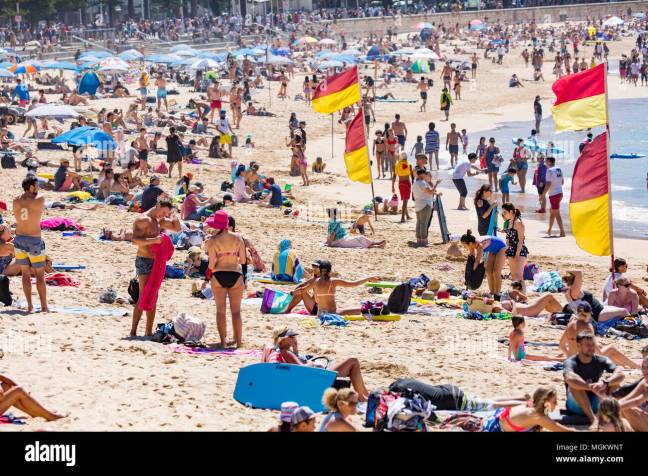
I am blessed to live in a beachside suburb on the south coast of New South Wales in Australia, along which coast there is a whole string of churches that are less than a kilometre, some only a few hundred metres, from the beach. So what do we see on this, what is a warm, cloudless Easter morn?
Firstly, If I go down to the beaches, on what is a very warm day, what will I find? It won’t be hundreds, but thousands of people on the local beaches, a large proportion of whom have been there from early morning (to secure a pitch), and I know from previous experience that the chances of me finding somewhere for me to park my car are minimal. It is also relevant to note that those beachgoers will have driven past many churches all with invitations to Easter services in full view, yet just kept on going.
Secondly, the beachside churches holding Easter worship services will no doubt be full (although I have long since known that major festival service attendance numbers have little to do with normal Sunday attendance) as hundreds of Christians celebrate Jesus’ sacrifice for us. However, in those services there will be little if any reference to, or weeping for, the thousands practising their Christ-less ‘recreation-worship’ on the beaches (or other inland places of recreation); the very people for whom Jesus died, and for whom the Church exists, who despite the sunshine actually live in darkness.
How much more must God be raining tears on this Christ-dismissing country, that received but now ignores all the blessings of the gospel and worships a whole range of recreational/sporting/pleasure ‘gods’ in place of him.
Could it be that this is the generation in which Latimer’s candle, preserved and brought at great cost across the seas, dies in these lands?
Or will we weep God’s tears also for those Christ-rejecting millions around us consigned to eternal darkness. Will we look out from within the four walls of our churches this Easter and have Jesus’ compassion, even weep for, the (in my case) ‘beachgoers’ who are so physically near yet so far from the Kingdom?
Will we pray again for ourselves and His now diminished and enfeebled church, to be filled with the power of the Spirit of the God whose tears fall as rain from heaven on the corruption, degradation, spiritual desiccation, and bankruptcy of Christendom lost. Such that God’s tears may cease.
It is of course, as we consider those questions, worth asking another question regarding the two worship practices happening today on the beaches and in our churches –
Where would the Jesus who said ‘I have not come to call the righteous, but sinners’ actually be today?
Discover more from unbounded church
Subscribe to get the latest posts sent to your email.

If our day was his day, I have no doubt he would be on beach mission.
If his day is our day (as in today) then I have no doubt he is with every Christian, through his Spirit, wherever they may be.
The question is, where would the Spirit have us be, and what would he have us do, but ‘go and make disciples of all nations, baptizing them in the name of the Father and of the Son and of the Holy Spirit, and teaching them to obey everything Jesus has commanded’? (Mt 28:19-20)
It took Jesus 3 years to make disciples of those whom he called to be with him. The question for individual disciples then is: ‘whom have I called to be with me in Christ for the next 3 years, that they may follow me as I follow Christ?’ (1 Cor 11:1)
The focus here is in teaching Christ’s commands, and leading and demonstrating a life of obedience. To make disciples, we must first be discipled!
LikeLike